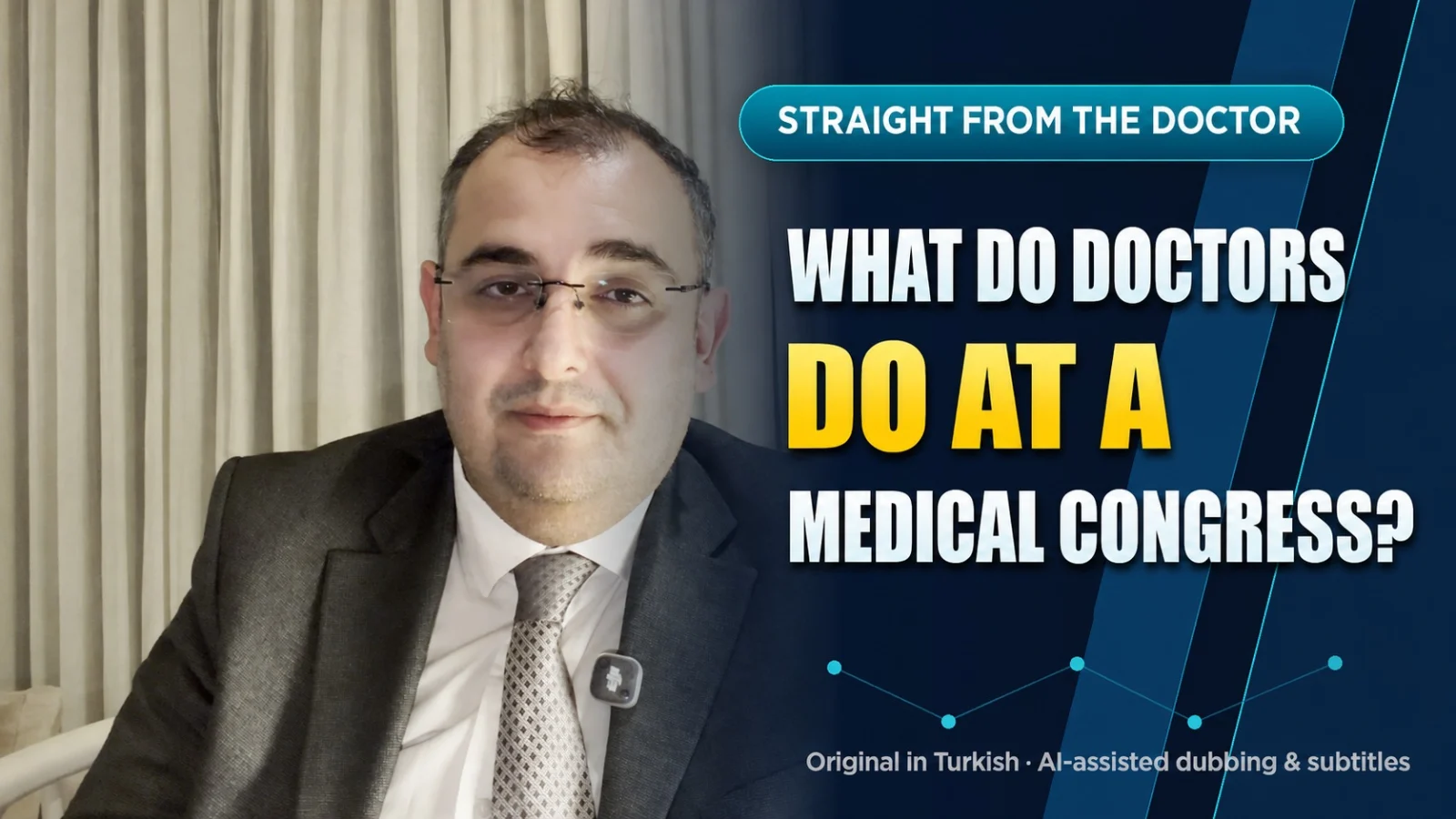
“Doctors go to a conference, spend a few days at a nice hotel and return. But what do they actually do there?”
It is understandable to wonder about this. Conference photographs often show hotels, crowded halls and doctors gathering together. They do not always reveal the scientific programme, the experiences shared or how these meetings relate to everyday medical practice.
After attending a cardiology conference, I wanted to answer this question through my own experience. Conferences are more than meetings where we listen to presentations: they are places to meet colleagues, discuss difficulties and review what we know.
What does a day at a medical conference look like?
Programmes vary. At the last conference I attended, the scientific programme began around midday on the first day and continued into the evening. On subsequent days, sessions ran from early morning until the evening.
During these sessions, we listen to presentations, review cases and discuss different approaches. We learn how other centres address questions we encounter in our own daily practice.
Sometimes we revisit a familiar subject. At other times, a case or a question raised during a discussion draws our attention to a detail we had not previously considered.
The exchange does not necessarily end with the scientific programme. Conversations over dinner or during a short break can continue to cover hospital conditions, clinical practice and the challenges we face.
If information is online, why meet in person?
Today, we can access an article, attend an online course or follow a conference remotely. The conference I attended was also available to watch online.
These opportunities are valuable. Travelling to another city is not essential simply to obtain information.
However, watching a presentation is a different experience from speaking directly with its presenter. Asking about a detail, describing a situation you have encountered and hearing about someone else’s experience are important advantages of meeting in person.
Just as personal communication matters in the doctor–patient relationship, knowing one another and speaking directly also have a place in communication between doctors. Conferences provide opportunities to build and maintain these relationships.
Why share difficult cases and unexpected problems?
In medicine, we do not learn only from cases that go smoothly. Discussing what we did when something unexpected happened and how we managed it is also important.
At this conference, we presented an unexpected problem that occurred during a procedure in which I was part of the team, and explained how we resolved it. Other sessions explored similar difficulties and possible solutions.
These discussions go beyond asking, “What was the outcome?” We also consider which options were available, why a particular approach was chosen and whether an alternative might have been possible.
Sharing experience is incomplete if we discuss only successes. Examining difficulties openly may help colleagues prepare for a similar situation.
Of course, a solution that worked in one case cannot be applied in exactly the same way to every patient. Shared experience needs to be considered alongside scientific evidence and the individual patient’s circumstances.
How can communication between colleagues help patients?
When we meet colleagues from different cities, we discuss more than medical information. We learn about the facilities available at different centres, their areas of experience and how their teams work.
This can have practical benefits for patients.
For example, a patient we follow may move to another city or need an assessment there. Knowing colleagues in that city and understanding the facilities available can help us make an appropriate referral.
Similarly, a difficult situation may call for another doctor’s opinion. Established professional relationships can make it easier to draw on different experiences when needed.
What matters is not simply knowing a large number of doctors, but being able to exchange views and find support that meets the patient’s needs.
Why does learning never end in medicine?
Graduating from medical school or completing specialist training does not mean that learning is finished. Everyday medical practice requires us to keep using and reviewing what we know.
At conferences, we become students again in a sense. We listen to teachers and colleagues, take notes and ask questions.
There is no written examination at the end. Instead, we encounter the practical relevance of what we have learned in the clinic, on the ward or during a procedure. A patient’s situation may show us where our knowledge is sufficient and where we need to improve.
It is therefore important not only to acquire knowledge, but also to keep it current and usable. Conferences are one part of this process; reading, online education and everyday clinical discussions are other ways to learn.
The personal and social side of conferences
Conferences do have a social side. We spend time in pleasant surroundings, share meals and talk with colleagues. This need not be seen as the opposite of scientific exchange. Sometimes a discussion that begins in a session continues over dinner.
Attending a conference also means spending time away from the usual work routine and from family.
Personally, I might prefer to spend a few days of free time with my family. Nevertheless, I value the experience gained through face-to-face conversations and shared discussions.
For one doctor to attend a conference, colleagues who remain at the hospital also have to share the workload. Participation therefore depends not only on an individual decision, but also on the support of the department and its team.
Frequently asked questions about medical conferences
Do doctors only listen to presentations at conferences?
No. Depending on the programme, there may also be case discussions and question-and-answer sessions. Conversations with colleagues outside formal sessions can be an important part of sharing experience.
Isn’t watching a conference online enough?
Online broadcasts are a valuable way to access information. Attending in person offers different opportunities to ask questions directly, meet colleagues and discuss individual experiences. The two approaches can complement each other.
Is everything learned at a conference immediately applied to patients?
No. An approach described in a presentation or used in a single case may not be suitable for every patient. Its scientific basis and the individual patient’s characteristics need to be considered together.
Does attending conferences alone make someone a better doctor?
It is not a measure of quality on its own. What matters is being open to learning, evaluating information critically and applying it to patient care when appropriate.
Can these relationships help when referring a patient to another city?
They can. Knowing colleagues and the facilities available at different centres may make it easier to arrange an assessment suited to a patient’s needs.
Conclusion
Medical conferences involve more than the hotels and meeting halls visible from the outside. Reviewing scientific knowledge, discussing difficult cases and listening to colleagues from different centres are important parts of these meetings.
The internet makes information easier to access. Face-to-face communication provides another setting in which to discuss that information and share experience.
For a doctor, the real value lies not in the number of meetings attended, but in how thoughtfully the learning is carried into everyday practice. At the centre of that effort is the aim of providing better care for our patients.